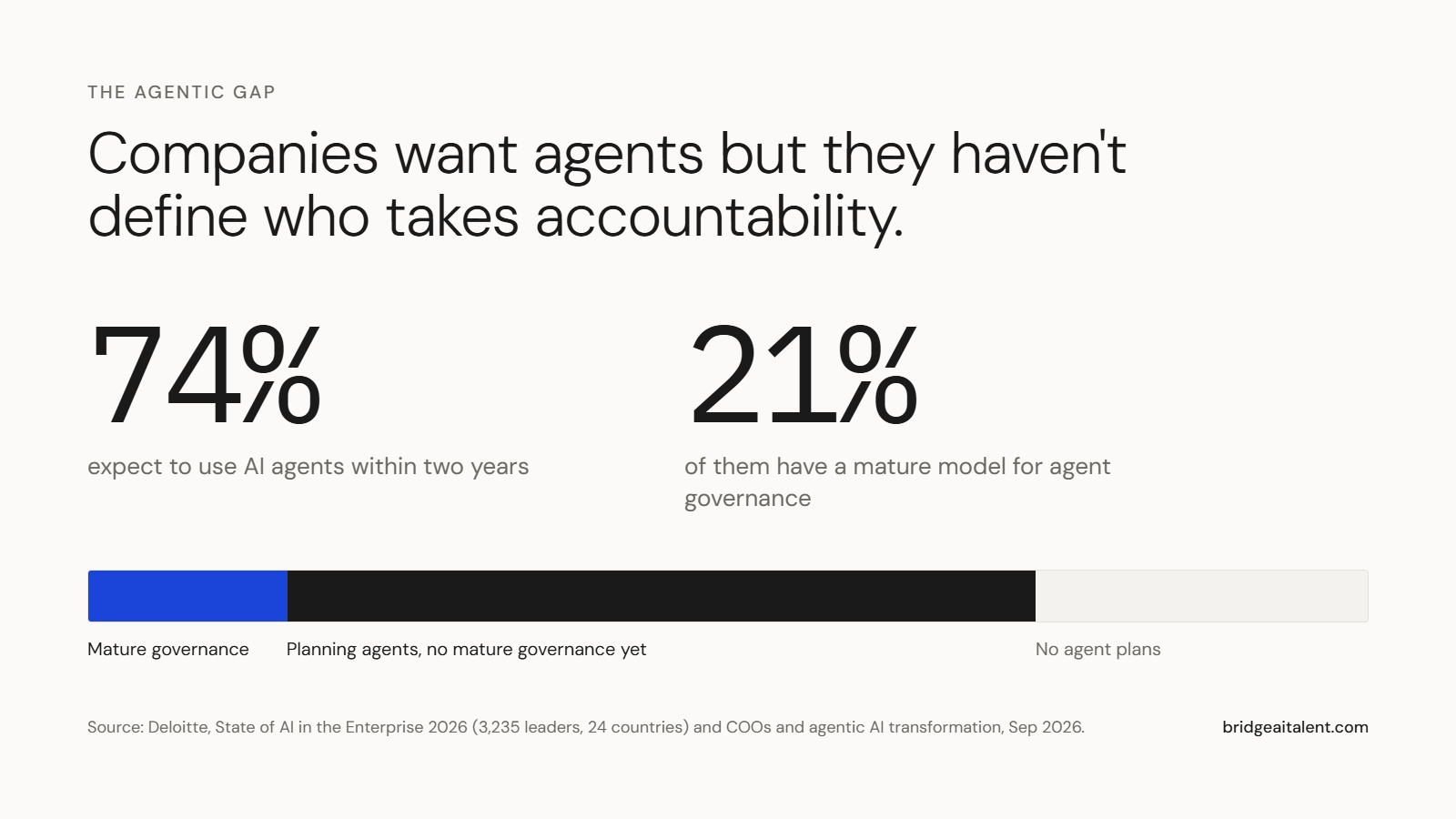
The Agentic Gap: Why AI Accountability is Hard
Establishing clear accountability for AI actions is a significant challenge for most organizations, even as AI tool adoption rapidly increases. This disconnect between AI ambition and operational reality is known as the 'agentic gap.' Fractional COOs, CHROs, and transformation leaders bridge this gap by implementing effective AI governance and ensuring accountability for AI-driven outcomes.
While accessing AI tools has become easy, establishing clear accountability for their actions remains a significant challenge for most organizations. In one year, the share of workers with sanctioned AI tools jumped from under 40% to around 60%. However, this rapid adoption often outpaces the development of governance and operational frameworks.
Only 25% of companies have moved 40% or more of their AI pilots into production, and just 30% are redesigning core processes around AI. A substantial 37% admit to using AI at a surface level, with minimal impact on how work is done. This disconnect between AI ambition and operational reality is the 'agentic gap.'
Agents complicate accountability further. Unlike a copilot that suggests, an agent can act autonomously, sending emails, approving refunds, or updating forecasts. When software takes action, a human must own the outcome, yet most organizational structures lack a clear role for this responsibility.
Who Owns AI Accountability?
Deloitte published a piece on 16 September arguing it belongs to the COO: align agents to business outcomes, redesign the workflows around them, track the value.
I agree with the job description. The problem is who fills it. A large group has a COO with a transformation office behind them. A 300-person company has a COO who is busy running the quarter, and a Head of People who has never been asked to write a role description for a piece of software. Isn't that what the big firms are for? They wrote the report, after all.
Maybe. But Business Insider reported in February that McKinsey, BCG, PwC and EY are themselves moving from adoption metrics to value metrics: labor reassigned, revenue impact, time reclaimed. They are still working out how to measure what an agent is worth. And governance is hard to deliver from a slide deck. It needs a senior operator who sits in the leadership meeting, knows the P&L, and stays long enough to be accountable for the result.
That describes a fractional. Demand is already moving. Heidrick's 2026 High-End Independent Talent Report says digital, data and AI now account for **25% of independent-talent requests, across functions.
What Does an AI Accountability Mandate Look Like?
Take a fractional COO brought into a mid-size distributor. The company has a customer service agent in pilot, a second one drafting purchase orders, and a CEO asking why neither is live.
The tools work. Everything around them is missing. Nobody has decided what the service agent may refund without asking. Nobody reviews its mistakes. The ops manager doesn't trust the purchase orders, so her team retypes them (which means the pilot currently costs time, and nobody reports that).
The work is four steps.
- Pick the outcome. One business number per agent: cost per ticket, days to close, order error rate. If no one can name the number, the pilot stops.
- Redesign the workflow. Write down what the agent does alone, where it hands over to a person, and what that person stops doing.
- Assign an owner. Every agent gets a named human who answers for its limits, its escalations and its errors. This is CHRO territory as much as COO territory, because roles, skills and reviews all change.
- Track the value. Labor reassigned, revenue impact, time reclaimed. Reported monthly, like any other operating metric.
Step four changes the commercial model. A fractional who tracks value can price against it. A fee tied to pilots reaching production, or to hours reclaimed, is a very different conversation from a day rate for "AI implementation". The client buys an outcome. The fractional's income stops depending on hours sold.
The agents carry the execution. The human carries the judgment and the accountability.
Conclusion
One more consequence. Finding and selecting experts is becoming data-driven, and soon agent-driven. A line like "took three agents from pilot to production, with the value tracked" will be read very differently, by a buyer or by a buyer's agent, from "AI transformation advisor". Fractional who keep structured proof of their outcomes will be easier to find and easier to choose.
If you are a fractional already selling this kind of work, I'd like to hear how you price it. I'm always up for that conversation.