1. Why Buyers Are Formalizing Fractional Work Now
Fractional leaders, also known as fractional executives, are senior professionals who provide specialized expertise to companies on a part-time or project basis, typically for a defined period. The numbers explain why buyers are formalizing this work now. In the Fractional Jobs 2026 report, 60% of engagements last six months or more, and 91% of fractionals do hands-on execution, beyond advice. The typical posting asks for about 10 hours a week.
Someone who spends half a year building systems inside a company, a few hours at a time, stops looking like a visiting advisor. HR notices. Procurement notices. Then they write a process.
The HR for Humans piece is built on an interview with Janel Abrahami, who worked in HR at NBCUniversal, Stitch Fix and Tinder. Her advice to employers is practical:
- Write a RACI for every workstream the fractional touches: who is responsible, accountable, consulted and informed.
- Onboard them deliberately, into the same SOPs, meetings and OKRs as full-time staff.
- Give access based on the decisions you ask them to make, and handle confidentiality with a contract and NDA.
- Build knowledge transfer in from day one: documentation, an internal shadow, recorded working sessions.
- Check regularly whether the scope is creeping toward a full-time job.
- Treat build, borrow or hire as a workforce-planning decision.
I'd sign every line of it. She also expects companies to move toward "planning in hours and outcomes." That is the same shift we see from the expert side: senior expertise coming loose from the full-time seat on the org chart.
2. Who Is Defining the Terms of Engagement?
Partly, this is good news for fractionals. Clear decision rights and real onboarding fix the problems that quietly kill good engagements: scope creep, authority nobody defined, a handover squeezed into the last week.
But look at who is writing the manual.
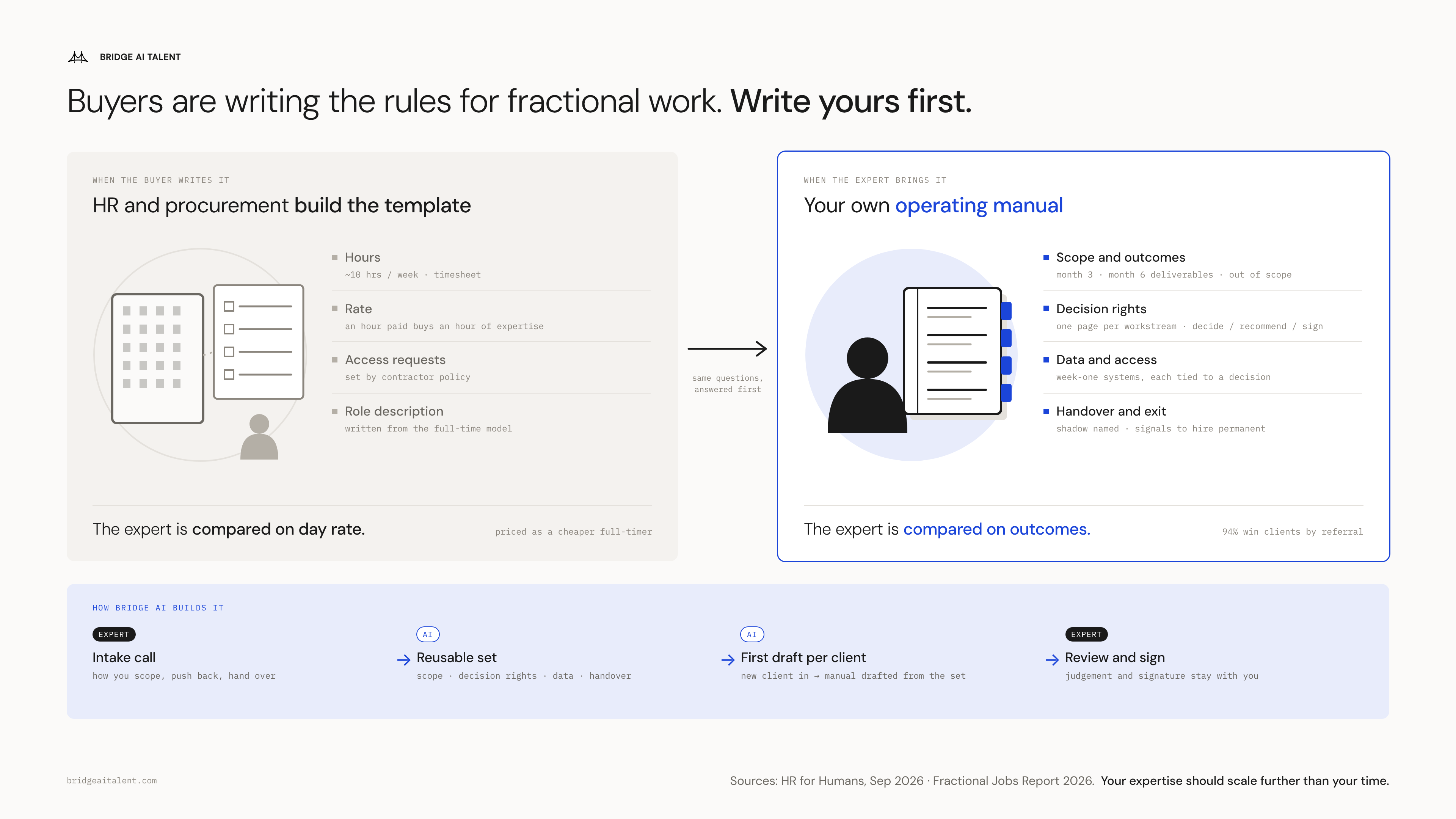
HR and procurement build templates from the models they already run: employees and contractors. Templates measure what they can measure. Hours. Rates. Access requests. A role description.
Abrahami names the risk herself. The most common mistake she sees is companies treating fractional as a cheaper full-timer, where an hour paid buys an hour of expertise. A generic template pulls in exactly that direction. What the client is buying is pattern recognition from someone who has solved the problem before, and that does not fit in a timesheet.
If the buyer's template defines the engagement, the expert gets compared on day rate.
3. What to bring to the first meeting
Show up with your own operating manual, before anyone asks for it. It answers the questions HR is about to ask, from your side of the table:
- Scope and outcomes. What you own, what is delivered by month three and month six, and what is out of scope. Abrahami's test helps here: does the work need to be designed, or does it need someone present every day? Fractional fits the first.
- Decision rights. One page per workstream. Where you decide, where you recommend, who signs off.
- Data and access. The systems and documents you need in week one, each linked to a decision you have been asked to make.
- Handover and exit. How knowledge gets captured as you go, who shadows you, and the signals that say the role should become a permanent hire.
The last one feels odd to write. A fractional explaining when to replace themselves. It is also the part buyers trust most, because it shows whose outcome you are working for.
It pays back in the channel that matters most for fractionals. 94% have won clients through referrals. A clean exit, with a team that can run what you built, is what people refer.
4. Why the written version wins
Take a CEO choosing between three fractional CFOs. She has three CVs and three rates. One of them also sent a draft operating manual with the proposal.
That candidate has already answered the questions HR was going to raise in week three. The engagement looks lower-risk before it starts. And the conversation moves from price to outcomes, because the outcomes are already on the page.
There is a second effect. I expect buyers to run more of their vendor reviews, onboarding and access requests through their own systems, with AI tools sitting inside them. A method written down in a clear structure is easy for those systems to read. A method that lives in the expert's head is invisible to them.
5. Where Bridge AI fits
Most good fractionals already have this manual in their head. They know how they scope, when they push back, what they need on day one. It just isn't written anywhere a buyer can read it.
That is the work we do at Bridge AI. We start with an intake call to capture how the expert actually runs an engagement. Then we turn it into a reusable set: scope, decision rights, data needs, handover. For each new client, the system drafts the first version from that set. The expert reviews it, adjusts it and signs it.
The system does the drafting. The expert keeps the judgement and the signature.
Closing
Buyers are going to formalise fractional work with or without the people doing it. I'd rather the first draft came from the expert.
If you run a fractional practice and want to write yours, let's talk.
Sources: *HR for Humans, "Fractional Talent Needs More Structure, Not Less" (7 Sep 2026)* · [Fractional Jobs, The Fractional Work Report 2026
](https://www.fractionaljobs.io/the-fractional-work-report)