I was listening recently to Elizabeth Stone, CPT from Netflix on Lenny’s Podcast and something she said stuck with me: systems thinking is now the most important skill she looks for when hiring people.
Netflix, she said, is hiring fewer narrow specialists and more people who can think across domains and define the building blocks everyone else builds on top of.
I think this points to a much broader shift in knowledge work. As AI takes over more of the tasks we used to perform ourselves, the value of human expertise is moving up a level: from doing the work to architecting how the work gets done.
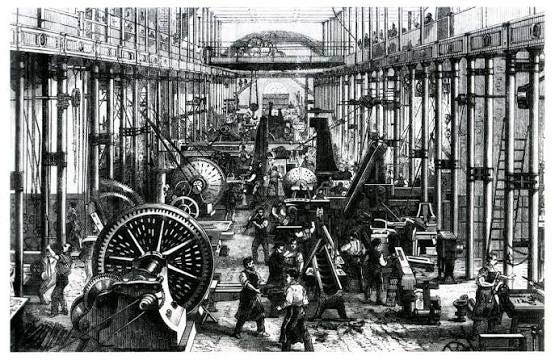
Let’s take a few (or many) steps back and learn from first industrial revolution in the lates 1700s. Something very similar happened to manual labor: machines started replacing hands, and production became faster, cheaper, and scalable.
And what happened to us, humans? We moved up a level.
Our ancestors started engineering and running the machines. Others moved into managing the mills or building the next one.
That opened an exceptional era of exponential growth and wealth creation and life improvement.
I believe the same will happen to knowledge work.
We are moving from task expertise to system expertise.
Let’s take the example of a CFO of a 10M USD revenue company.
A few years ago, being a good CFO meant being excellent at a series of tasks: closing the books, reconciling accounts, chasing invoices, building the cash flow forecast, preparing the board deck. Super time consuming with high risk of mistake along the way.
Now, with the right set up, a structured database, automated reconciliation and checks, and a bit of AI on top, machines can already handle most of the mechanical steps in that chain: reconciling accounts, categorizing transactions and flagging variances against budget.
But it doesn’t make the CFOs irrelevant. Quite the opposite. They can leave the mechanical part to machines and move one level up. Some may choose to engineer their own system, some other may decide to use a pre-engineered one and focus their time and attention on what’s uncertain and still come back to human to decide. That’s where their judgement, their trust and their capacity to influence a decision make a difference.
As an example, a fractional CFO we are working with, with no AI background, recently used pre-engineered system to clean up 8 years of accounting across three legal entities, transfer pricing included. The transfer pricing work alone saved the company more than $100K.
A few years ago, that scope would have required a team of specialists. She didn’t need one. She just needed to know what to look for, and what a wrong answer looks like.
That’s the real skill: judgment, accountability, and the ability to think in systems.
Few tips to help you develop system thinking
So if boundaries are shrinking, are we all becoming generalists?
Again, I think it’s almost the opposite. I believe expertise will eventually become more vertical. People owning domain expertise such as payment, people functions or transformation will be able to create a much bigger impact in the space they operate.
But there is one caveat. This will be true only if they are able to extract themselves from the task and apply that expertise at the system level, while staying curious and open to change.
Take HR as an example. The best Total Rewards specialist will remain incredibly valuable if they combine two things: exceptional judgment in everything related to compensation and the ability to think about their expertise as a system.
The same is true for engineering, recruiting, design or any other function.
And so, could a brilliant HR leader use AI to start solving finance problems? Probably.
If they’re curious and learn extremely quickly, the technical barriers are getting lower every month. But why throw away 15 years of accumulated pattern recognition?
The bigger opportunity is to take those 15 years of expertise and apply them across a much larger surface area.
A senior HR leader can now operate across recruiting, compensation, performance and organizational design. AI provides capabilities they didn’t previously have. Their expertise provides the judgment to connect those capabilities into a coherent system.
This is why every company may hire fewer people. And therefore, every person we hire will need to create more leverage.
For the more junior people, I would highly recommend optimizing for curiosity, hard work and AI fluency. Hiring manager will care less about whether they already know how to perform every task, because many of those tasks can be learned or augmented quickly.
For senior people, the bar is different.
Same soft skills, but they may have to bring something additional that AI cannot manufacture overnight: years of domain-specific pattern recognition and judgment.
This combination becomes extremely powerful.
Someone who has accumulated deep expertise in a domain and can now embed that expertise into systems can operate at a scale they could never achieve alone.
In a way, that’s exactly what happened during the industrial revolution. Human capability didn’t disappear when machines arrived. It moved up a level.
I think that’s a much more exciting way to think about the years ahead.
Let’s move up a level.